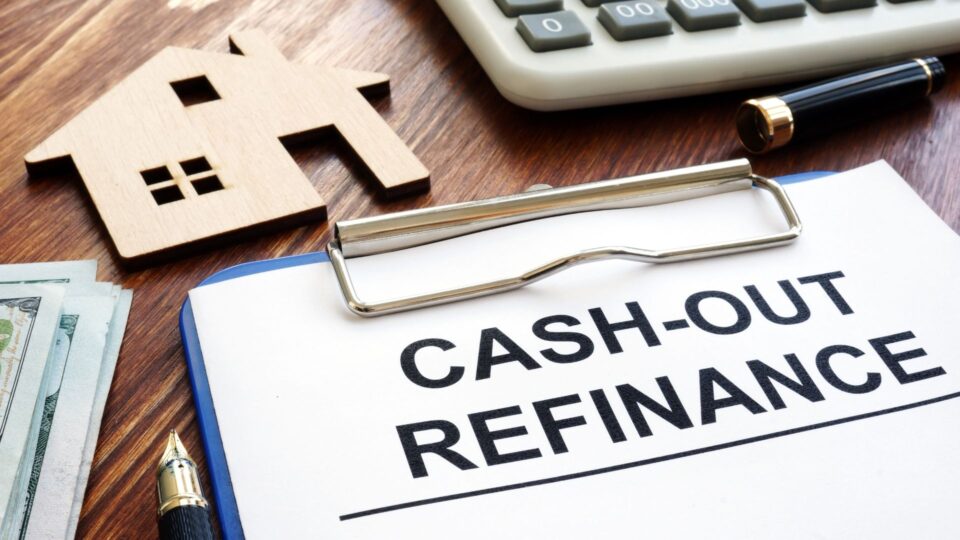
A cash-out refinance happens when investors refinance a home in order to extract equity from the property. They take out a new loan to pay off their existing mortgage and, if the new loan is larger than the previous loan, they can use the difference to use as a rehab budget or to invest in other properties. A cash-out refinance essentially lets you unlock the cash in an illiquid investment.
A cash-out refinance, also known as a “cash-out refi,” can finance up to 80 percent of a property’s current appraised value. This means you need at least 30 percent equity in a property for a cash-out refinance to make sense. For example, a house worth $150,000 can be refinanced with a loan up to $112,500, derived as:

If your existing mortgage balance is at or higher than $112,500, then a cash-out refi would only make sense if you wanted to lock in a lower interest rate. Investors with existing mortgage balances below $112,500, however, can use the new loan to pay off the existing mortgage. For example, if your current loan’s principal balance is $100,000 and you refinance with a $112,500 loan, you would have $12,500 left over to invest elsewhere.
Therefore, the three important components of a cash-out refinance are:
Typically, investors apply for a cash-out refi and, if accepted, the lender and the title company will handle paying off the existing loan via a wire transfer. The borrowers then receive their excess funds in “cash,” which is usually in the form of a wire to their bank or a certified check from the title company.
A cash-out refinance is typically used by investors who have at least 30 percent to 40 percent equity in an existing investment property. These investors use a cash-out refinance to extract their equity and purchase either a new investment property or renovate an existing investment property. The new loan amount must be higher the old mortgage balance and the difference is pocketed in cash.
Looking to purchase, renovate, and flip a new investment property.
Looking to put a down payment on a new property or purchase it with all cash.
Looking to renovate an existing rental property.
(LTV): Up to 75% LTV
Typically 7-10 business days
Interest only or amortized
There are no restrictions on how investors use the cash from a cash-out refinance, so that’s why it’s right for different investors. Therefore, the money earned on a cash-out refi can be used to renovate an existing long-term rental property in an attempt to increase its value and its rental income.
It can also be used to finance a short-term fix n flip project as well as a long-term rental property. The funds can also make it easier to compete with all-cash buyers for foreclosures or properties sold at real estate auctions. Regardless of intention, investors need an existing property in order to execute a cash-out refi.
Your credit score is low (Under 600)
Self-employed business owners
You do not claim all of your income on your tax return
Non-U.S. citizen and receive non-documented payments
You are unemployed and do not meet the income requirements for a traditional loan
Your debt to income ratio is poor
Despite its name, there are still some pieces of paperwork you will generally need to supply with this type of loan. For example, the lender may still require a credit report in order to determine your current credit score. In addition, the lender will want to get an appraisal of the home in order to make certain the amount of the loan is worth the value of the home. It is possible to obtain one of these loans without this paperwork as well, but it is generally much more expensive.
+1 (615)909-3641